Not a Shield, Not a Stage: The Camera as a Bridge
Not a Shield, Not a Stage: The Camera as a Bridge
Social anxiety has been a part of my life for as long as I can remember. Because of that, getting into photographing people was a challenge. On one side there was curiosity and the desire to do it. On the other side there was fear and discomfort.
This is where the camera became a tool that could be used in two very different ways - either as a shield or as a bridge.
It’s interesting how the same thing can serve completely different purposes depending on how we choose to see it and use it. For a while, the camera functioned as a shield. A safe protection where I could hide and feel more comfortable despite my social anxiety.
Recognizing that led to a decision to challenge that mindset and step into the discomfort, as scary as it felt.
For the next three months a 35mm lens stayed on my camera and went everywhere with me. Photographing people up close meant there was no zoom to rely on. The only option was to “zoom” with my feet and get physically closer.
At the beginning, the discomfort often got the best of me. But with time, curiosity and the love for photography started to overpower the fear. Slowly, the camera began to transform from a shield into something else.
A bridge.
Instead of creating distance, the camera began to create connection. Photographing someone became a way of sharing a brief moment of attention and presence with another person.
One experience from that time stands out clearly.
During a festival in Covington, KY, I was drawn to two people dancing to the music a band was playing. There was something about their energy. They seemed completely submerged in the moment, enjoying themselves and caring little that people around them were watching.
I wanted to preserve it.
The first reaction, however, was discomfort - the feeling of intruding on something private.
Instead of walking away, I let their emotion pull me into the moment and made what became the first image from this experiment that truly felt meaningful.
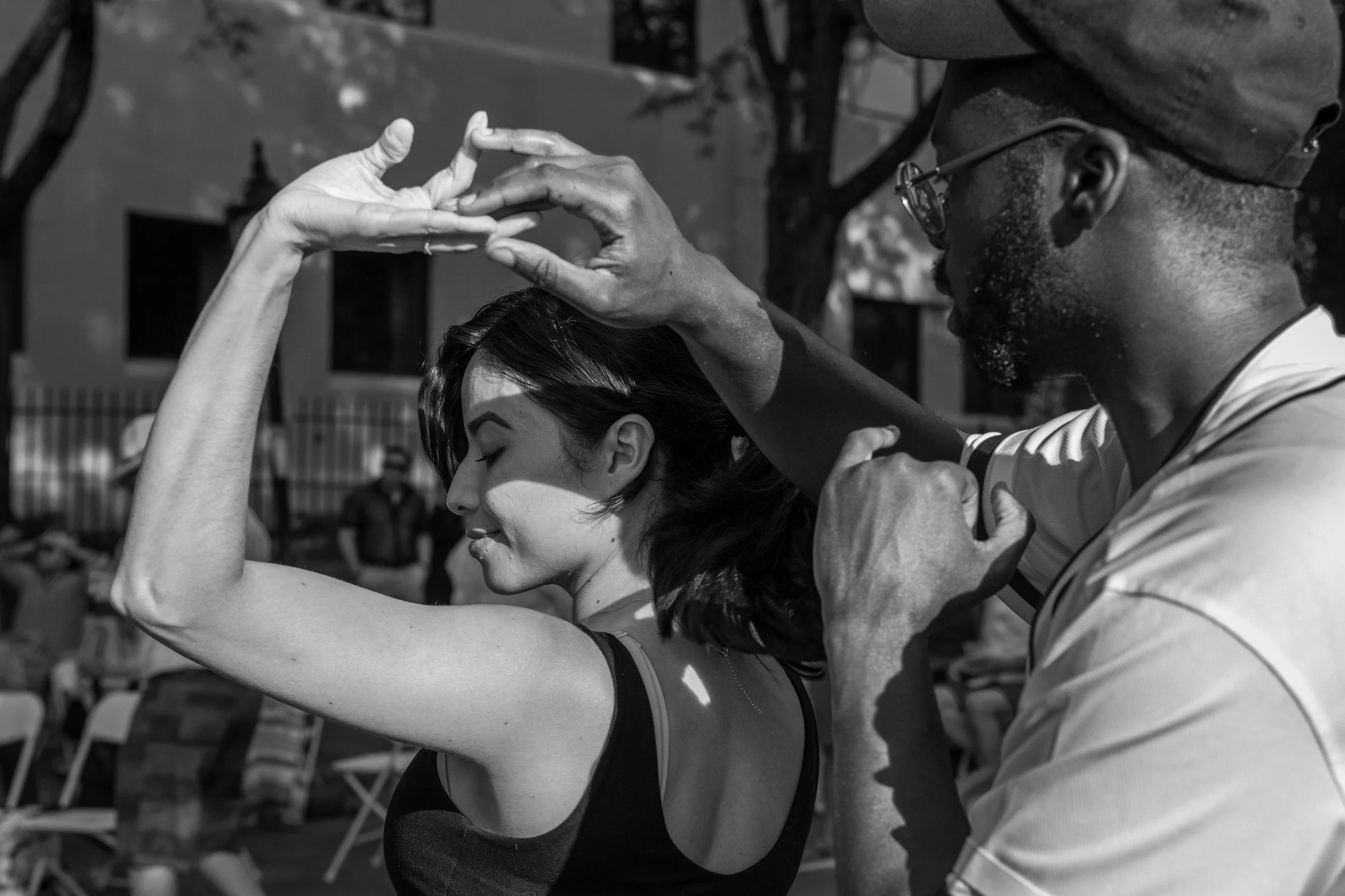
Right beside them, feeling the energy of the dance - the camera as a bridge to the moment, not a barrier.
In that instant came the realization that the whole process had been approached the wrong way. The assumption had been that the uneasiness needed to disappear before photographs could be made.
But the opposite turned out to be true. The anxiety itself could be fuel - something that simply needed to be channeled in the right direction. The goal was not to eliminate it, but to learn how to use it.
That realization changed how I approached photographing people.
At last year's Mountain Workshops, my coach - photojournalist Kathleen Flynn - said something that has stayed with me:
“If you are not nervous, maybe you should go home.”
That nervousness never really disappears. It still shows up when stepping closer to photograph someone.
The difference is that the camera is no longer something to hide behind.
It’s simply the bridge that allows the moment to exist.
And often, that nervousness is exactly where the most meaningful work begins.